
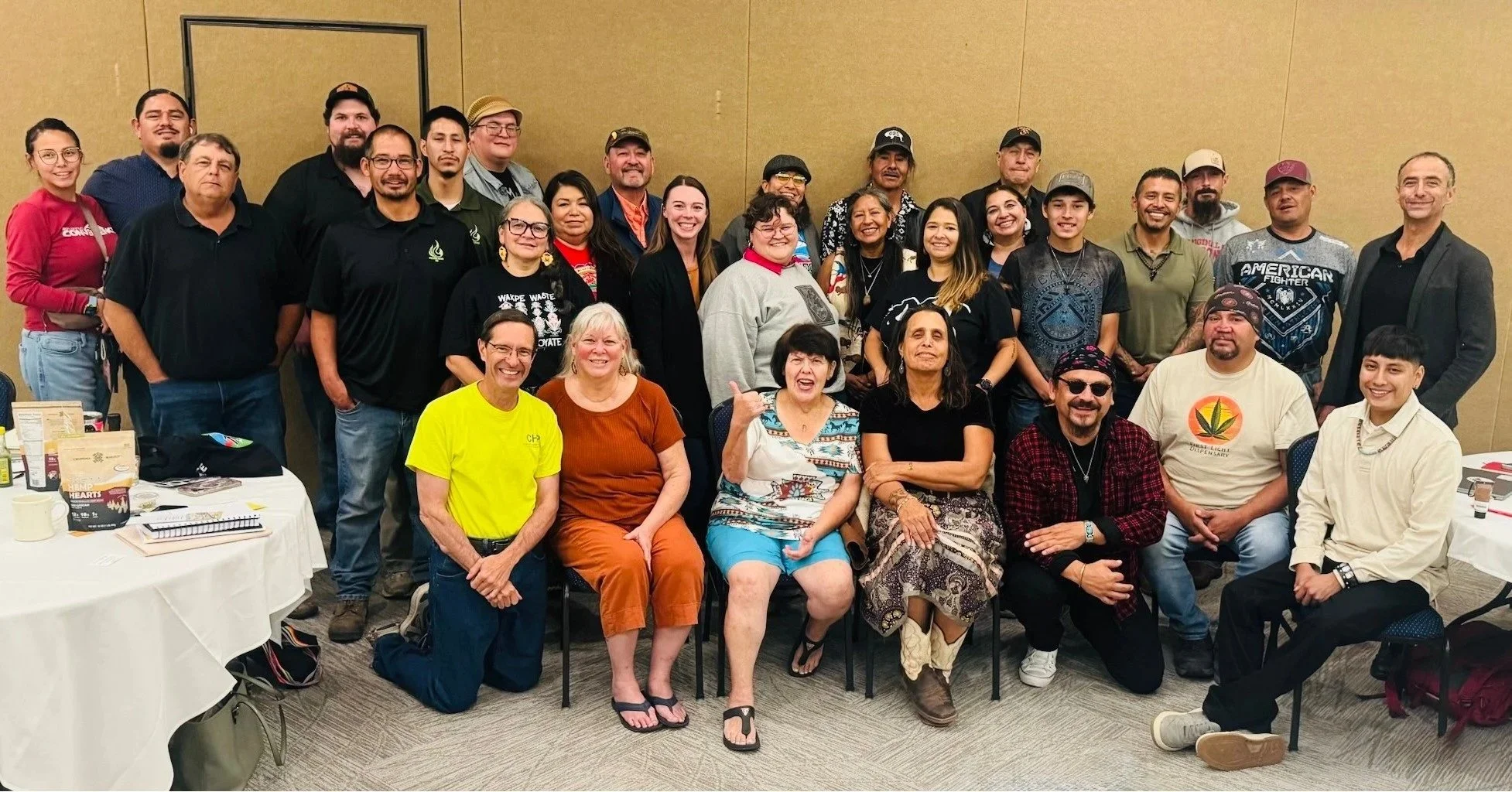
The Indigenous Hemp and Cannabis Farmers Cooperative Association is a group of
Indigenous farmers, builders, weavers, and allies to Mother Earth who want to grow
hemp. We are primarily interested in fiber hemp, because of the very significant
potential of this plant for housing, to sequester carbon, to clean our Mother Earth and to
transform the materials economy from fossil fuels to plants. Our work is to inform
Indigenous farmers and our allies about the plant and the possibilities of this plant. We
are not experts, we are seed keepers, people who keep traditional knowledge, and we
are interested in making a good future for our descendants and relatives. We are
learning together, and we are interested in creating a vertically integrated hemp
economy, from the seed to the house based on respectful relationships.
About our History
The Cooperative was formed in 2022, by some Dine and Anishinaabe farmers an weavers who shared the same values. We had all just begun to grow hemp in our communities, and saw the potential of this work, particularly in textiles and housing. We were inspired by the great words and work of John Trudell and Alex White Plume
who remain some of the visionary leaders of this time. We just wanted to begin.
Since that time, the Indigenous Hemp and Cannabis Farmers Cooperative, in collaboration with Anishinaabe Agriculture Institute and the Dine Pueblo Latino Cultural Center have done much. Shay Vandever produced a stunning textile of Dine Churro Wool and hemp ,which adorned a model at a New York Fashion Week. We began much of our work at the Anishinaabe Agriculture Institute on the White Earth reservation Anishinaabe Agriculture Institute (AAI) and our sister organization Akiing, are committed to the Green Path. One of the key strategies we have is the development of the fiber hemp economy, which not only bioremediates soil, but sequesters carbon at the highest rate of any field crop. Over the three years, we have purchased 800 acres of land in this region, both to protect the watershed and village, and to create an integrated crop rotation with hemp, beans, corn and sunflowers. We have been farming for thirty years, and hemp in specific for eight years under state and federal permits, as well as partnerships with the University of Minnesota, Dine weavers and artisans, Patagonia and the New School for Social Research. We have also begun to create new partnerships with conservation organizations and watershed associations. We are ready to be at the table, and we are ready to set the table for the restorative economy. That will take some political and legal pressure accompanied by economic transformation. That’s our work and it is focused on hemp.
Over the past five years, Anishinaabe Agriculture has sponsored five Indigenous Hemp Conferences, a class- Tribal Hemp l0l. sponsored on line by tribal colleges in the Northern Plains, and produced a workbag with Patagonia, using our hemp, and undertaken pilot projects in hemp building. With the support of the Bush Foundation, we were able to launch the Indigenous Hemp Cooperative, and support farmers and seed development regionally on the Cheyenne River, Rosebud, Yankton, Pine Ridge, Sisseton , Red Lake, Oneida and other reservations. With the University of Minnesota, we’ve been engaged in research to create land based hemp varieties so that farmers may own their seeds.
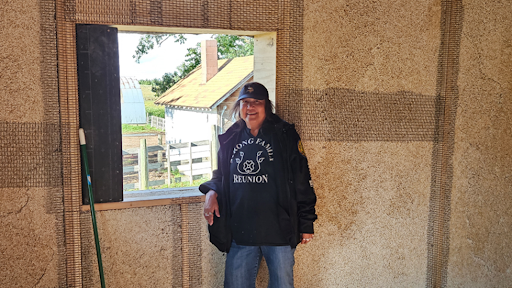
In the summer of 2023, we were able to test build our first hempcrete addition to a farmhouse using a set of panels made by Homeland Hempcrete in Bismarck North Dakota. The house has one foot thick walls and we will test it this winter. We built the addition in six hours with panels which had been fabricated. In 2023, we hope to replicate this technology to create affordable resilient housing for our communities and others. The White Earth reservation, like many other reservations, suffers from a significant housing shortage. In the upcoming year, we hope to create two elder houses on the White Earth reservation using our hemp building techniques. This technique, we believe, is replicable to the Indigenous nations in our region, and the Navajo reservation. The Pine Ridge reservation for instance needs to build l0,000 households for tribal members, and we believe those houses could be built in a climate change resilient manner, with hemp. The Navajo reservation has a similar challenge. Our hope is to prototype a model which is replicable. We believe that hemp is an essential part of the transformation from a hydrocarbon to a carbohydrate economy. We call this the New Green Revolution.